
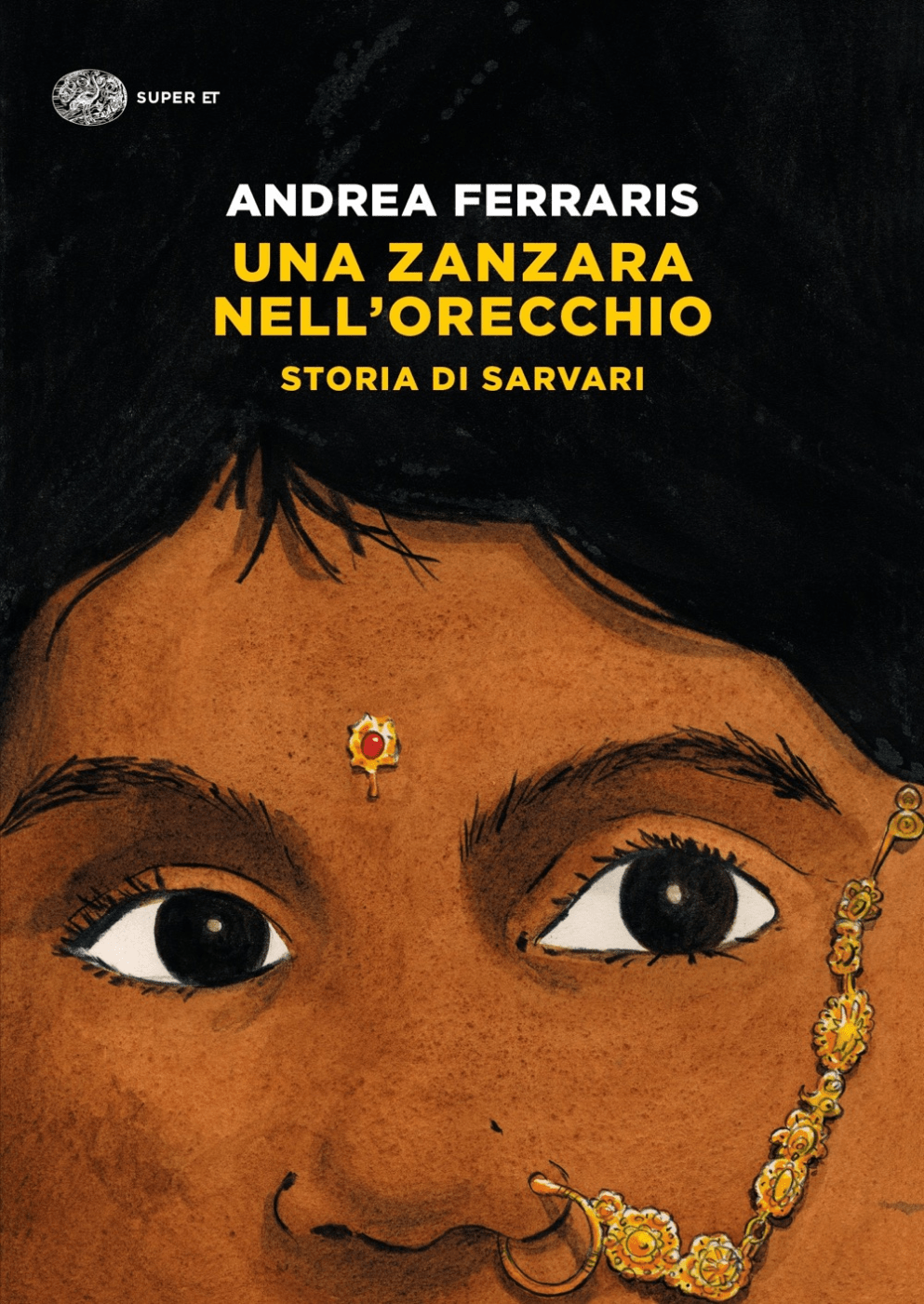
For Andrea Ferraris, adoption has had a huge impact on his life. In his graphic novel A Mosquito in the Ear, the Italian author captures how that single word changed his familiar world, pulling him and his wife Daniela into a long, uncertain journey filled with paperwork and waiting for a child they had yet to meet. What began as a distant idea becomes something far more immediate when they learn the name of the little girl they will adopt—Sarvari—and travel to Mumbai, where hope and doubt collide in ways they never expected.
More than just a memoir, A Mosquito in the Ear is a story about what it means to build a family across languages and cultures. Through expressive artwork and unfiltered storytelling, Ferraris documents the logistical realities of international adoption and the emotional, more difficult moments—the uncertainty, exhaustion, and the fragile beginnings of connection that don’t always come easily. It is a narrative that resists perfection and offers readers the unfiltered truth.
To better understand the story behind the book, I spoke with Andrea Ferraris himself, his daughter Sarvari, and Alessandra Sternfeld, the senior agent who helped bring the project to life. Together, their perspectives reveal a layered and intimate portrait of the story: from the author who lived it, to the daughter who grew up within it, to the editor who recognized its honesty and helped shape how it reached readers. What emerges is the story of a family that was brought together through adoption, and the heartwarming moments along the way.
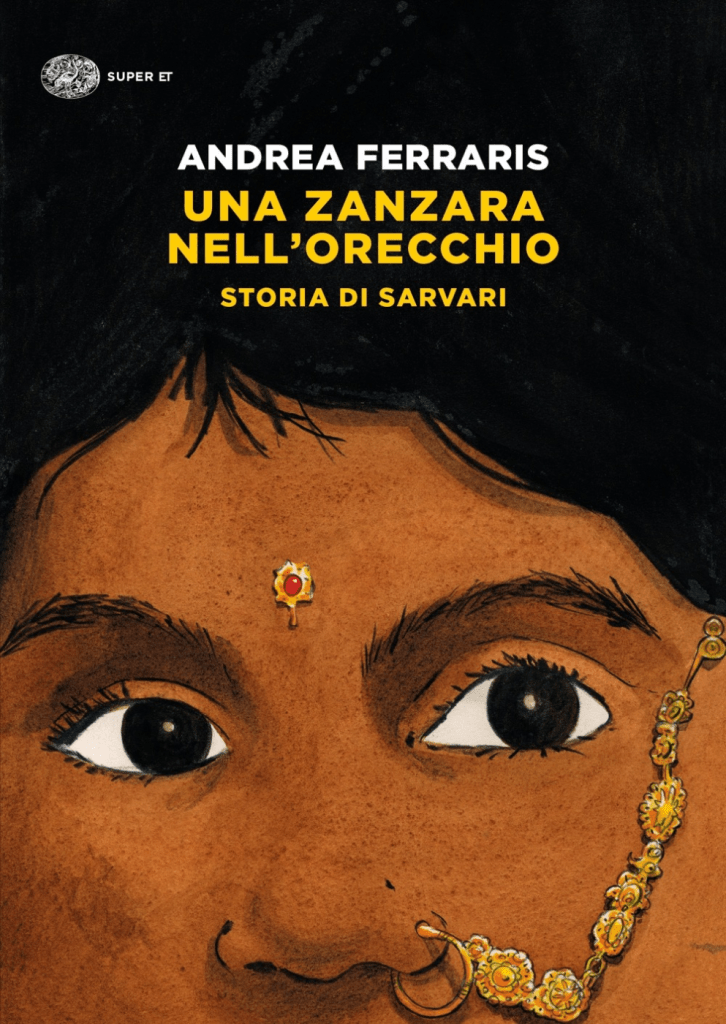
A Mosquito In the Ear book cover 
Andrea Ferraris and his family 
Alessandra Sternfeld, senior agent at am-book 
Andrea Ferraris, Sarvari Ferraris, and Daniela Ferraris at the film premiere of A Mosquito in the Ear 
Sarvari Ferraris 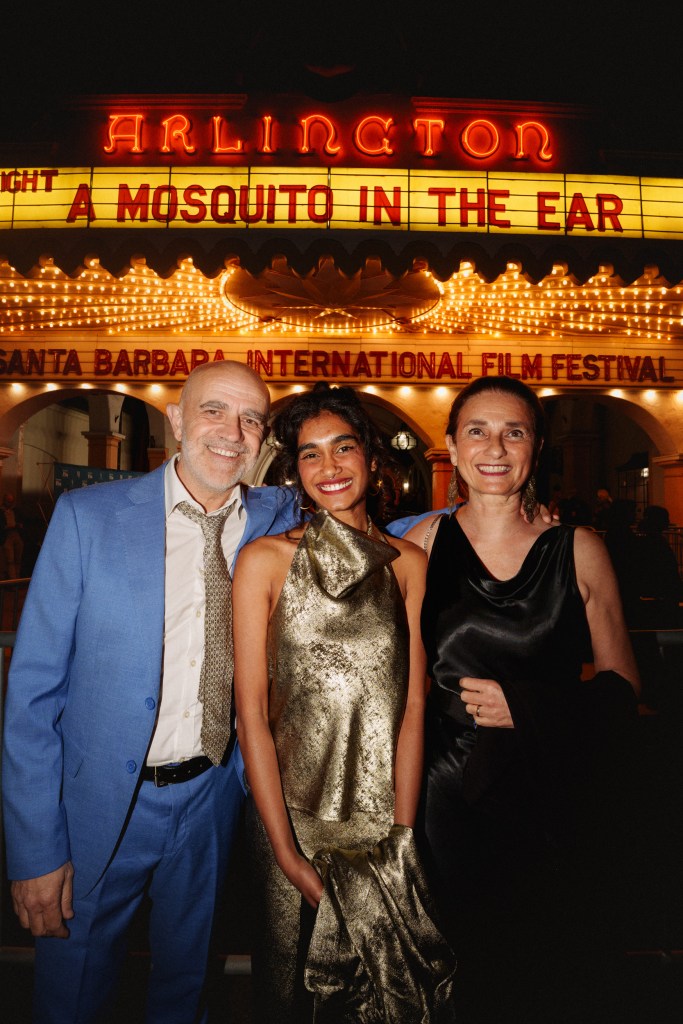
Andrea Ferraris, Sarvari Ferraris, and Daniela Ferraris at the film premiere of A Mosquito in the Ear
Ferraris, an Italian comic book artist, did not set out to write a traditional adoption narrative. “It’s natural for me to imagine telling what happens to me or what I see,” he explains, reflecting on the moment his personal experience began to take shape as a graphic novel. “So such an emotional story immediately made me think to transform it into a graphic novel.”
The book traces Ferraris and his wife Daniela’s journey through international adoption, from the long, bureaucratic waiting period to their eventual trip to India to meet their daughter, Sarvari. As Ferraris describes it, “this is the story of our journey through the bureaucratic process and personal growth that prepared us for a trip to India… that was truly magical but also challenging, emotionally speaking.” It is the duality of magic and difficulty existing side by side that defines the work and sets it apart from more simplified portrayals of adoption.
Alessandra Sternfeld, senior agent at the publishing company am-book, recognized this honesty immediately. “The story had a very heartfelt quality to it,” she says. “It was easy to empathize with Andrea and Daniela’s struggles as new parents of a girl who didn’t want to have much to do with them.” Rather than smoothing over those struggles, Sternfeld and her team emphasized them when bringing the book to publishers. “We highlighted the fact that it was a true, honest story that—to some extent—strayed from the dominant narrative that adoption is an easy magic waiting to happen,” she explains. “We stressed that it is indeed a nuanced process that moves forward by trial and error, and that… requires an effort and a certain amount of grief and pain from both sides.”
That honesty is perhaps most powerfully captured in the story behind the book’s title. Ferraris recounts a moment early in their time with Sarvari, when communication felt nearly impossible. “During the first few weeks, the biggest challenge had been communicating with her, even just to reassure her,” he says. “Sarvari spoke Marathi and cried constantly. She cried for 15 days straight.” One evening, they saw her laughing with an interpreter, Sister Aruna, who explained that Sarvari thought she had a mosquito in her ear. “Daniela and I looked at each other warmly, and we asked ourselves, would we ever be able to connect with her like that?” he recalls. “It seems to us that that mosquito perfectly symbolized that moment of great difficulty.” This is where the book’s title comes from, and Ferraris said, “We never even considered changing it.”
The metaphor lingers throughout the narrative: a mosquito represents a small, persistent discomfort that mirrors the varied emotions, doubt, and exhaustion that accompany such a life-altering transition. It also reflects the book’s willingness to sit with discomfort rather than resolve it too quickly.
For Sarvari herself, who is now 24 and an actress living in Rome, the story has always been personal, but she’s glad to see the work become relatable to others. “At the beginning, I would say this is the most difficult and emotional part,” she says of seeing her life depicted in the graphic novel. “On one hand, I was happy that many people could relate to my story. On the other hand, I realized that something that was mine, personal, had now become public.” That tension eventually shifted as she saw the impact the story had on readers. “Then I realized that it wasn’t just a story about me, it spoke about everyone and to everyone,” she explains. “Now I’m happy to talk and share my experiences.”
Sarvari was not just a subject of the book, but an active participant in its creation. Andrea Ferraris describes how he worked closely with both his wife and daughter throughout the process: “I would write and then have Sarvari and Daniela read it. They were the story’s first editors. Together we decided what should be included and what wasn’t necessary.” Sarvari, in turn, recalls carefully reviewing drafts and even pointing out inconsistencies in the artwork. “When I finished reading, I brought my father a sheet of paper with all the grammatical and logical errors in the drawings,” she says with a laugh. “For example, in the same scene, in different drawings, I didn’t have shoes. So it wasn’t logical in the timing of the story.”
Their collaboration adds another layer to the narrative, transforming it from a single perspective into a shared family story. “It almost created a stronger bond in this family,” Sarvari reflects. “We had something that the three of us could share. It’s a common story, a shared story, but also with different parts of each other.”
The graphic novel format plays a crucial role in capturing these layered perspectives. As Sternfeld notes, editing a graphic novel requires attention not just to text, but to the interplay between words and images. “You can’t consider the text only,” she explains. “You have to take into account the rhythm of the panels and the way they match—or don’t—with the text and the general atmosphere of the story.” This visual storytelling becomes especially important in depicting moments where language fails, such as Sarvari’s early days with her adoptive parents. “In the early days, Sarvari communicated mainly through looks, expressions, gestures, and body language,” Ferraris says. “For this reason, the comic highlights my own difficulty in initially connecting with her.”
Despite its deeply personal origins, A Mosquito in the Ear has resonated widely with readers from all backgrounds. Ferraris describes how people often approach him after events to share their own experiences. “It’s as if a door just opened between their experiences and ours,” he says, “and we can enter in a common space to share.” Sarvari echoes this sentiment, emphasizing the universality of the story. “I don’t think you have to fully understand my story,” she says. “For a good story to work, it has to be relatable to everyone. And everyone can see a piece of themselves in it.”
That relatable appeal has only expanded with the book’s recent film adaptation, which Ferraris describes as “a truly powerful emotion” to witness. The film premiered at Santa Barbara International Film Festival 2026, and sitting in a theater filled with 2,000 people, hearing their reactions to his family’s story, was an unforgettable experience. “I could hear the sound of their emotions,” he says. “And it was our story.”
At its core, A Mosquito in the Ear resists easy conclusions. Ferraris himself is hesitant to assign it a single message. “It’s not that there necessarily has to be a message behind telling a story,” he says. “But if I had to find one, I’d probably talk about a story of acceptance that moves in both directions… two desires and needs that, in our case, we managed to make work.” It is the mutual process of parents learning to love and a child learning to trust that defines the book’s emotional depth.
For readers, the result is a story that lingers long after the final page. As Sternfeld advises writers tackling similarly personal material, “Be true to your story. Do not stray from your experience trying to make something ‘palatable.’” Ferraris has done exactly that, offering a narrative that is as raw as it is hopeful. And perhaps that is why A Mosquito in the Ear resonates so deeply: because it shows, without sugarcoating the experience, what it actually means to become a family.
