
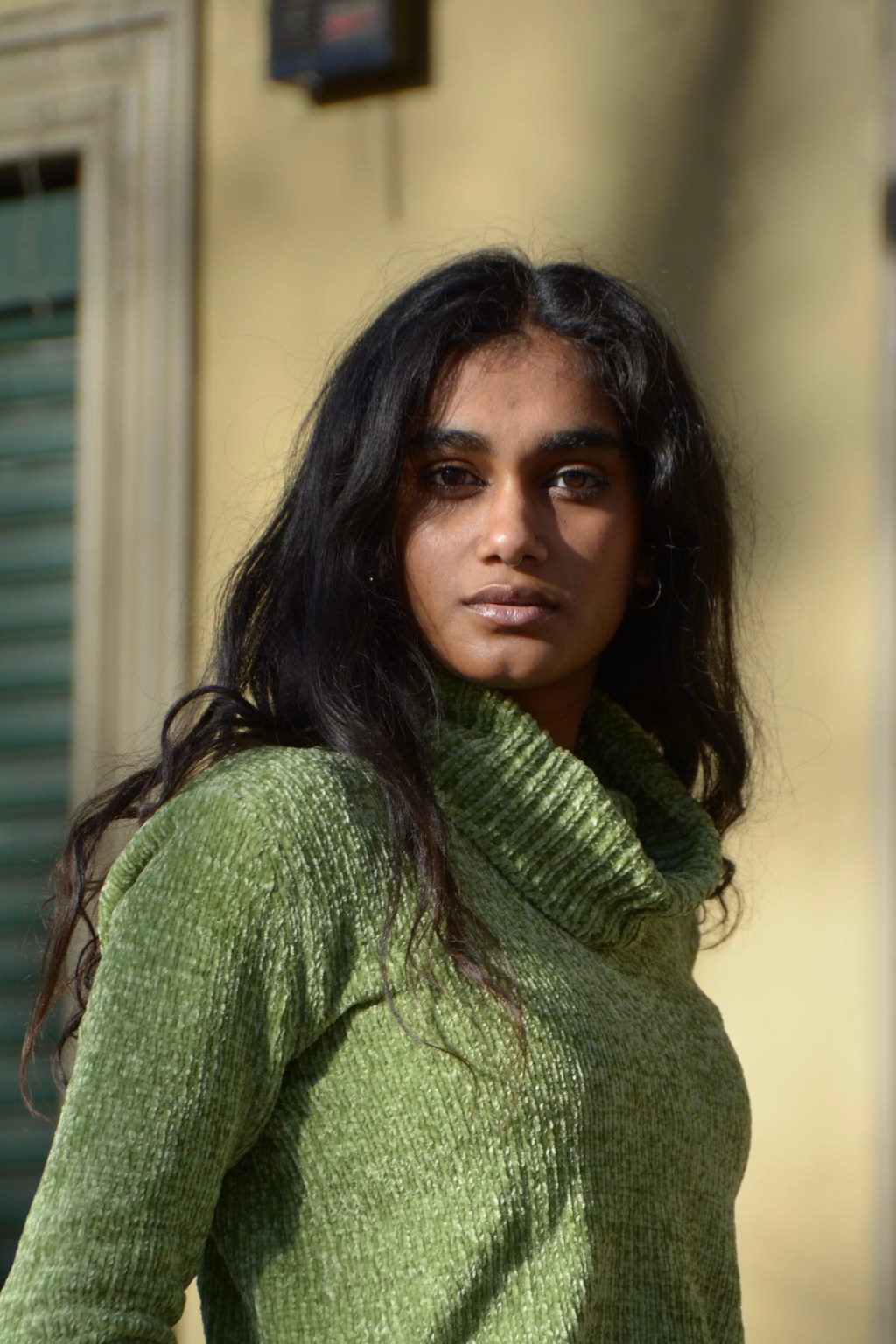
By Teesta Bhola-Shah
A Mosquito in the Ear is not your typical coming-of-age story. Told through the lens of a graphic novel, it follows the journey of one family’s international adoption experience, tracing the story of a young girl from India into a new family, and the challenges and connections that unfold along the way. At the center of that story is Sarvari Ferraris, whose life inspired the book.
Now 24, Sarvari is an artist in her own right, building a creative career while reflecting on the narrative that features her. I had the opportunity to speak with her about what it means to see her life transformed into a widely shared story, and how her perspective has evolved over time. Her insights reveal a deeper, more personal dimension of A Mosquito in the Ear and go beyond the pages of the book. They reflect the complexities of growing up with a story that is both yours and, in many ways, no longer entirely your own.
Sarvari is now building a creative life of her own as an actress, exploring film, dance, and music. “Cinema, it’s part of my life concretely,” she says. “And I enjoy this hobby that now is becoming a work and a job for the arts… acting, but also dancing and singing. And I can explore all of that. And that’s amazing.” And as she forges her own artistic path, her story resonates with the world as well.
Growing up with a father who is both an artist and a storyteller meant that creativity was always part of her environment. “He’s definitely been an artistic inspiration since I was little,” she explains. “I’ve tried to copy his drawings. And now I find myself pursuing my dreams thanks to their support.” But A Mosquito in the Ear was not simply her father’s project—it was, as she describes it, “quite a group effort,” with Sarvari herself playing a surprisingly active role. “I was acting as a supervisor,” she says, laughing. “And for example, the story was originally supposed to come out when I was in middle school, but I wasn’t ready. So as a supervisor, I postponed it until high school.”
That hesitation speaks to the deeply personal nature of the story. Adopted at four and a half years old, Sarvari carries what she describes as fragmented memories of her early life. “I still have some flashes… it’s not really a memory, but more a flash that I can’t say if it’s truly like that or just a sensation,” she explains. These impressions, which were very uncertain and difficult to fully articulate, made the idea of seeing her story told publicly both intriguing and intimidating.
During the early stages of the book’s creation, Sarvari kept a certain distance. “Every now and then I’d go into his studio and ask him if the story was progressing or not,” she recalls. “And sometimes I’d see him pulling out some old photos or objects. And when he did that, I tended not to get involved… perhaps it’s because I didn’t feel this was part of my story.” At that point, the narrative still felt like something belonging to her parents and their experience to adopt, not necessarily hers.
That changed as the story moved closer to her own memories. “When he got to the part about India, I started checking more closely,” she says. “Even having him change my face if I didn’t recognize it in his drawings or correcting parts of the story if I remember it differently from them.” In those moments, Sarvari transitioned from observer to collaborator, ensuring that her perspective was represented in the final work.
Her role became even more concrete when she reviewed an early draft of the graphic novel. “They were so emotional,” she said, reflecting on her parents when the draft arrived. Taking her time with the manuscript, she approached it with a critic’s eye. “When I finished it, I brought my father a sheet of paper with all the grammatical and logical errors in the drawings,” she explains. “For example, in one scene I had shoes and in another I didn’t. So it wasn’t logical in the timing of the story.”
Still, seeing her life on the page was not easy. “At the beginning, I would say this is the most difficult and emotional part,” she admits. “On one hand, I was happy that many people could relate to my story. On the other hand, I realized that something that was mine, personal, had now become public.” That loss of control was definitely unsettling for her at first. “People that I’ve never met… they ask me a lot of questions as they know me, but I don’t know them,” she says.
Over time, however, her perspective shifted. “Then I realized that it wasn’t just a story about me, it spoke about everyone and to everyone,” she explains. “I realized that this story was powerful and it could send a message that I could help people open up.” Today, she speaks about the book with a sense of purpose, recognizing its ability to connect people across different experiences.
Working on the story also reshaped her understanding of family and identity. “It almost created a stronger bond in this family,” she reflects. “We had something that the three of us could share.” At the same time, she acknowledges that each member of the family holds a different perspective. “My perspective could be more about my sensation of the adoption, and for them, it could be more like a couple’s story. It’s a shared story, but also with different parts of each other.” This layered understanding adds depth to the narrative, reminding readers that no single version of a story can fully capture its complexity.
The timing of the book’s release also played a role in Sarvari’s personal growth. “The reason I didn’t want my dad to work on this story in middle school was because it was a very fragile moment of my life,” she says. “And after enough time, I realized I wanted to better understand who I was.” Through the graphic novel, she was able to see her story not only through her own lens, but through her parents’ as well. “My parents were able to tell my story in their own way… to see their perspective about my story.”
That evolving understanding extended even further when the book was adapted into a film. As an actress, Sarvari is no stranger to storytelling on screen—but seeing her own life transformed into a film was something she never expected. “When I heard the news, I couldn’t believe it,” she says. “I always thought… if there were ever going to be a biopic about me, it might happen after I died, maybe about my acting career.” The idea that her adoption story could hold that level of significance was surprising, almost surreal. “I kept telling myself, ‘That’s not true,’… that sooner or later, I’d step out of this Truman show,” she recalls. “This was an incredible experience.”
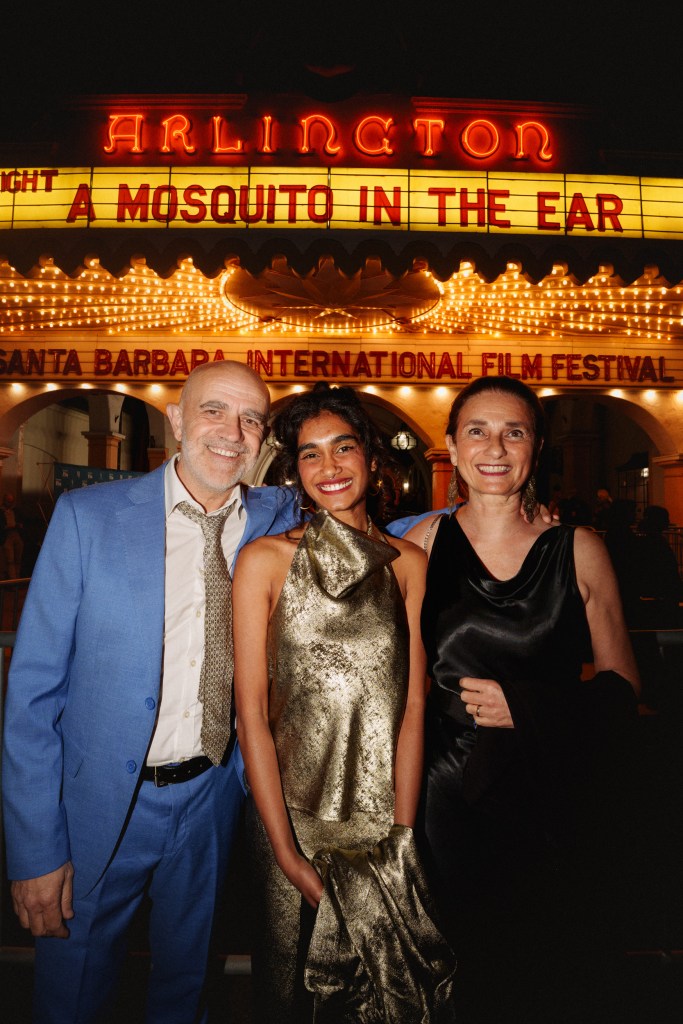
Despite its deeply personal origins, Sarvari believes the story’s strength lies in its universality. “I don’t think you have to fully understand my story,” she says. “For a good story to work, it has to be relatable to everyone. And everyone can see a piece of themselves in it.” This belief shapes how she hopes audiences engage with A Mosquito in the Ear, taking emotions away from it rather than a moral lesson. “I want them to be moved by this story,” she says. “I want them to use it like the ancient Greeks once used theater for catharsis, and I think we could almost call it universal.”
At its core, the story has also deepened her appreciation for the family that shaped her life. “Creating this comic has certainly made me realize just how much my parents love me and how long they waited for me,” she says. “I don’t think everyone keeps a drawer full of memories and videos so that one day they can create a work that tells the story of their daughter.”
And yet, despite her growing comfort in sharing her story, Sarvari remains grounded in her own personality. “In real life, I’m shy too,” she admits. “I hate exposing myself in front of people. And I prefer to do it if there is a reason.” For her, A Mosquito in the Ear provides that reason, giving her a story worth telling. A story that belongs, in some way, to everyone who finds themselves within it.
