
By Teesta Bhola-Shah
When people picture adoption today, they might think of families being brought together through agencies, with care for the children and intentional placement. But it wasn’t always this way.
Kerry Tobar, Adoption Education Manager at the Gladney Center for Adoption, explained that adoption in the U.S. started in a darker way. The earliest form of “adoption” began in the 1880s with orphan trains, where kids without families were placed on trains and sent throughout the country to find families. Children were taken from New York and sent westward, where families would choose them in public gatherings.
“Kids were literally auctioned off,” Tobar said. “Families would pick the biggest or healthiest-looking ones, and the rest were left behind.” The orphan trains created lifelong trauma for the children, as many were separated from their siblings and chosen by families who simply wanted them for farm labor.
Tobar continued, “Gladney was founded as a response to that. The whole point was to make sure children were placed with care, with dignity, and in families who wanted to love them.”
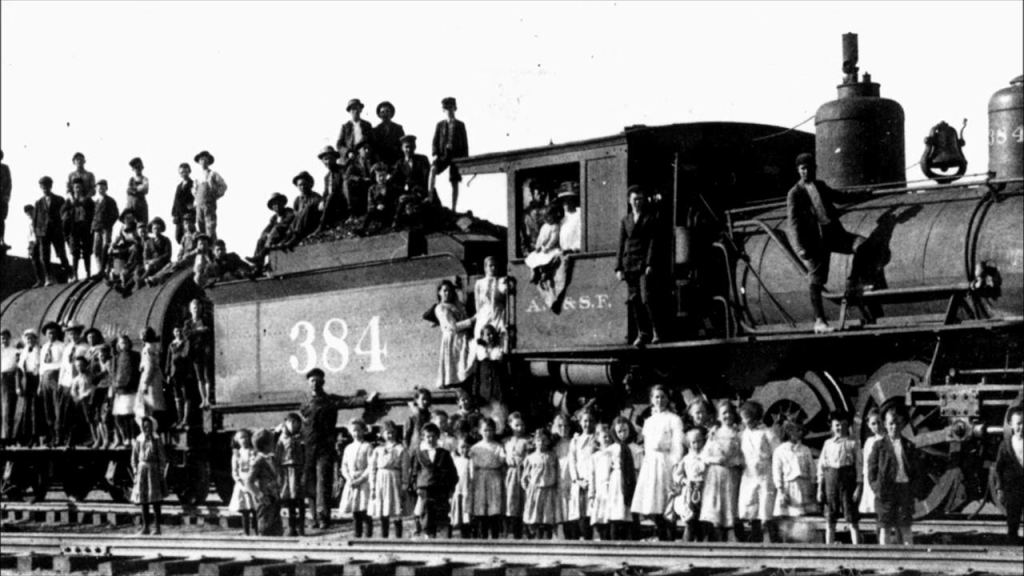
Adoption Trains in the 1860s (Image credits: PBS)
A Mission That Began in 1887
The Gladney Center for Adoption, which is now more than 140 years old, was created to do adoption differently. From the beginning, the organization focused on the needs of children and worked to place them in safe, loving homes.
“From the very beginning, the mission has been the same,” Tobar said. “It’s about the child — making sure they have a future, a home, and a family who is prepared for them.”
Adoption looks very different today than it did in the past, with the biggest difference being that the birth parents have the power now, not Tobar emphasized how the role of birth parents has shifted, giving them more power and choice in the process.
“Adoption today looks completely different than it did even 50 years ago,” she explained. “Birth parents now make the plan. They choose the family. They decide what level of openness feels right. It’s not about someone taking their child away — it’s about empowering them to decide what’s best.”
Why Language Matters
Tobar also spoke about the importance of language in adoption. She pointed out that the way people talk about adoption can either support or harm birth parents and adoptees.
“It drives me crazy when people say, ‘Oh, she gave her baby up,’” she said. “Nobody is giving up anything. She made an adoption plan. She thought about her child’s life and made the most loving choice she could. That is strength, not giving up.”
Looking back at adoption’s long history, Tobar reflected on the progress that has been made.
“When you think about where adoption started — orphan trains, children being treated like property — and you compare that to today, it’s incredible,” she said. “Now we have caseworkers driving birth moms to doctor’s appointments, adoptive families going through hours of training, kids getting lifelong support. That’s not even in the same universe as where we began.”
Tobar summed it up simply: “We’ve gone from auction blocks to empowered voices. That’s the evolution.”
And adoption does not end when a child is placed in a home. Gladney continues to provide services and support for adoptees and families long after placement.
“We get calls from people adopted 30, 40, even 50 years ago,” she said. “They want their records, they want to talk to someone who understands. Adoption is lifelong. That’s something the orphan trains never considered.”
“We’ve made huge progress,” Tobar said, “but there’s still so much work to do — in education, in awareness, in fighting stereotypes. Adoption is not a single moment. It’s a journey, and every voice in that journey matters.”
“At the end of the day, it’s about one thing,” Tobar said. “Making sure children are safe, loved, and seen. That’s what adoption is, and that’s what it should always be.”
