

By Teesta Bhola-Shah
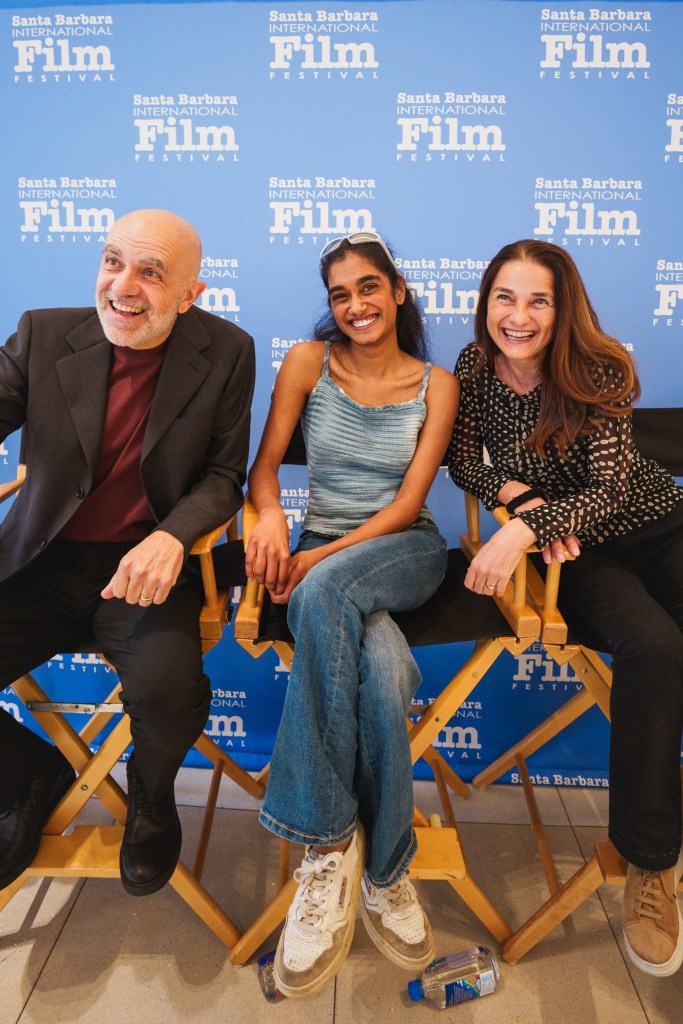
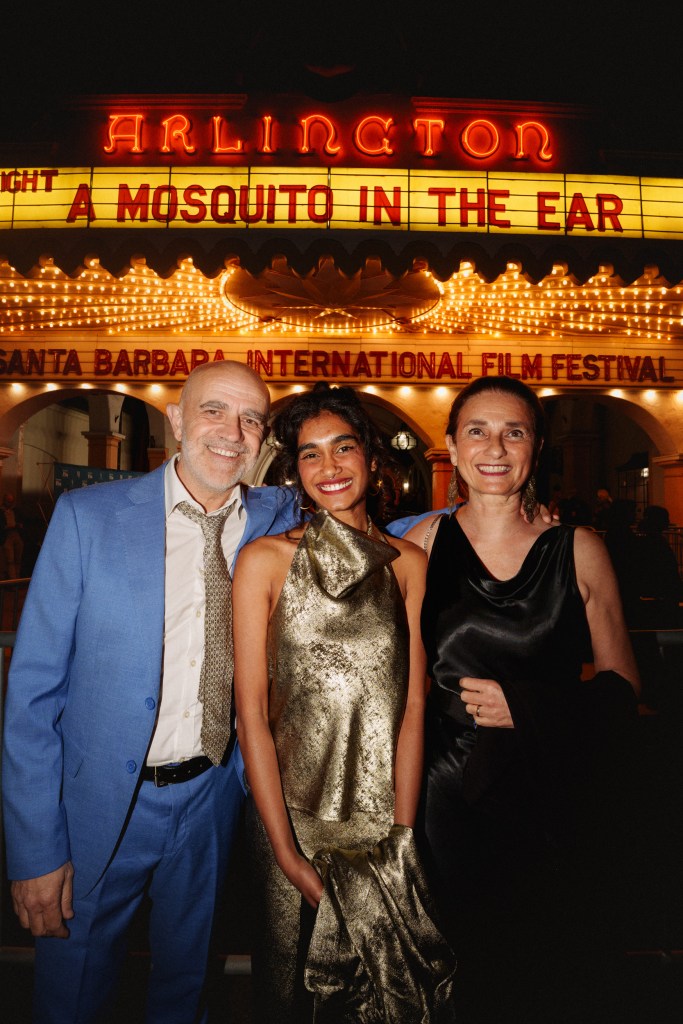
For Andrea Ferraris, storytelling has never been a choice, it has always been instinct. Long before his story A Mosquito in the Ear became an internationally recognized graphic novel and film, it was his family’s personal experience, one that Ferraris felt compelled to capture in the only way he knew how. “It’s natural for me to imagine telling what happens to me or what I see,” he explains. “So such an emotional story immediately made me think to transform it into a graphic novel.” His instinct to document and to translate life into panels and images became the foundation for a work that manages to be both universal and personal.
Ferraris did not initially set out to tell a story about adoption. In fact, as he reflects, it was not something he had long imagined for himself. “He never thought about adoption,” he says of his earlier life, noting how the idea gradually took shape alongside his relationship with his wife, Daniela. “I let her guide me, and the responsibility scared me at first.” What began as uncertainty slowly evolved into something deeper, as Ferraris found himself drawn not only to the idea of becoming a father, but also to the possibility of sharing that journey. “Little by little, he liked the idea of becoming a father,” he says, “and he enjoyed sharing this part of his life.”
The evolution from hesitation to acceptance is at the heart of A Mosquito in the Ear. The book does not present adoption as a sudden transformation, or sugarcoat the difficult parts. It shows it with honesty, as a process shaped by time and doubt. “This is the story of our journey through the bureaucratic process and personal growth that prepared us for a trip to India,” Ferraris explains. “That was truly magical but also challenging, emotionally speaking.” By placing equal weight on both the beauty and the difficulty of the experience, Ferraris creates a narrative that feels deeply honest, resisting the urge to simplify what is inherently complex.
The decision to tell this story, however, did not come immediately. It was years later, during the pandemic, when Ferraris first had the idea. “We revisited the trip through photos and videos,” Ferraris recalls, “and Sarvari asked for the first time when we might be able to tell the story in a graphic novel book.” That moment, prompted by his daughter’s curiosity, gave him the motivation to turn his family’s archive into the blueprints for his graphic novel.
Even then, shaping that story proved to be one of the most challenging aspects of the process. “That was the hardest part,” Ferraris admits. “I wasn’t writing this story alone. I would write and then have Sarvari and Daniela read it. They were the story’s first editors. Together we decided what should be included and what wasn’t necessary.” This collaborative approach ensured that the narrative did not belong to Ferraris alone, but reflected the perspectives and emotions of the entire family.
The title of the book, A Mosquito in the Ear, captures this sense of emotional tension in a single, vivid image. Ferraris describes a moment early in their time with Sarvari that would come to define the story. “During the first few weeks, the biggest challenge had been communicating with her, even just to reassure her,” he says. “Sarvari spoke Marathi and cried constantly… she cried for 15 days straight.” The exhaustion and uncertainty of those days reached a turning point one evening, when they saw her laughing with an interpreter. “Aruna explained to us that Sarvari was laughing because she thought she had a mosquito in the ear,” Ferraris recalls. “Daniela and I looked at each other and we asked ourselves, would we ever be able to connect with her like that?” For Ferraris, the image became symbolic. “It seems to us that that mosquito perfectly symbolized that moment of great difficulty and we never even considered changing the title.”
As a comic book artist, Ferraris knew instinctively that this story belonged in a visual format. “This is my favorite way to tell stories,” he says. “I never thought that I could tell this story in other ways.” The graphic novel medium allowed him to use art to convey experiences that go beyond words, especially emotions in the early days of his relationship with Sarvari. “In the early days, Sarvari communicated mainly through looks, expressions, gestures, and body language,” he explains. “For this reason, the comic highlights my own initial difficulty in connecting with her.” Through images, Ferraris is able to convey the silence, the distance, and the gradual emergence of connection in ways that prose alone might struggle to achieve.
Throughout it all, authenticity remained central to Andrea Ferraris’s approach, especially when portraying the cultural and linguistic challenges of international adoption. Rather than smoothing over these difficulties, Ferraris chose to emphasize them, allowing readers to experience the uncertainty alongside him. At the same time, he highlights the small but meaningful moments of progress, such as Sarvari quickly learning their language or forming friendships in their new environment. “We encouraged this friendship,” he says of a neighboring family, “and the two girls became like sisters.”
Since the book’s publication, Ferraris has been struck by the way readers respond to its honesty. “At presentations, people come to say hello… they feel the need and the pleasure to share their experiences,” he says. “It’s as if a door just opened between their experiences and ours, and we can enter in a common space to share.” For Ferraris, this exchange is one of the most meaningful outcomes of the project: the realization that a deeply personal story can allow others to reflect on their own.
That sense of shared experience has only expanded with the book’s adaptation into a film. Watching his story unfold on screen was, in his words, overwhelming. “When we sat in the theater for the film’s premiere, there were 2,000 people in the audience, and I could hear the sound of their emotions,” he says. “And it was our story. It was an unforgettable moment.” While the film remains faithful to the core of the narrative, Ferraris was particularly moved by moments that extended beyond the original book, such as a scene in which Sarvari dances in front of the television. “It’s a powerful thing,” he reflects, “demonstrating how skillfully the director immersed himself in our story… rendering it through this small, private, and yet universal scene.”
Despite the growing reach of his work, Ferraris remains grounded in the personal origins of the story. When asked about its message, he resists offering a definitive interpretation. “It’s not that there necessarily has to be a message behind telling a story,” he says. “But if I had to find one, I’d probably talk about a story of acceptance that moves in both directions. A parental desire on my part and Daniela’s, and a need for affection and attention on Sarvari’s part.”
Today, Ferraris continues to create, already working on new projects that explore themes of identity and his personal history. Yet A Mosquito in the Ear remains a defining work because of the honesty with which it has been told. In bringing his story to life, Ferraris has done more than document an experience. He has invited readers into it, allowing them to feel its uncertainties, its challenges, and connections, without losing the truth at its core.

One response to “Drawing a Family Into Being: Andrea Ferraris and the Story Behind A Mosquito in the Ear”
You have skilfully interviewed and depicted this very personal story which transformed into a book and now a movie for many more to see and experience.
Your writing inspires connection to your subject and subject matter. Look forward to your articles.
LikeLike