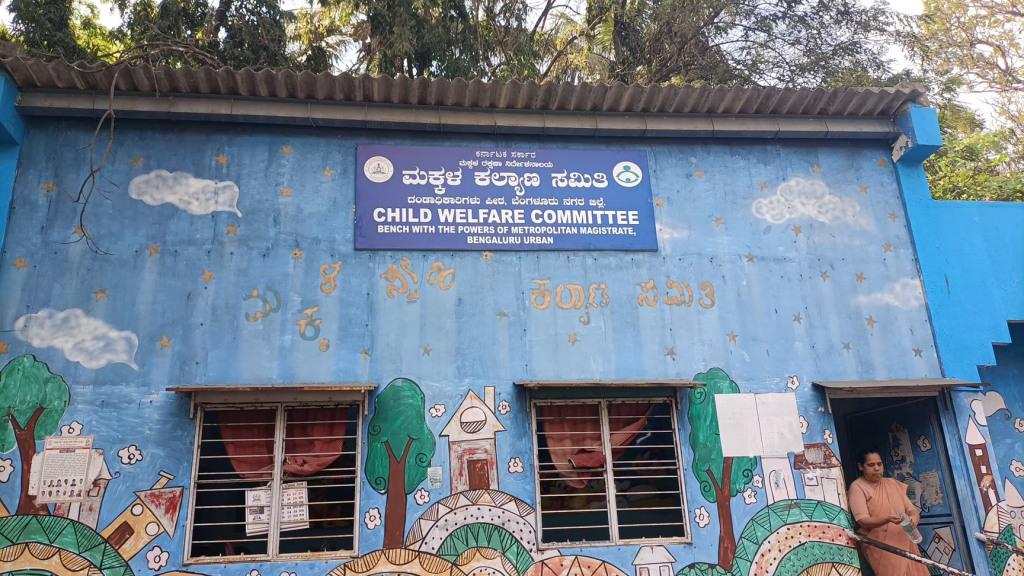
Leena Kallammanavar has spent nearly two decades working inside India’s child protection system, and she describes her job as a coordination effort. “We don’t work in a cocoon or as an individual person,” she told me. Her department, the District Child Protection Unit (DCPU) of Bangalore Urban Central, sits at the center of a web that includes the education department, the police, the labor department, the judiciary, and the social welfare and backward classes welfare departments. No single office, she says, can protect a child alone.
Kallammanavar entered the field as a Child Development Project Officer in 2008 and spent seven and a half years as superintendent of a Government Girls’ Home and Shishu Mandir, the state-run home for the youngest and most vulnerable children, before becoming DCPO eight months before we spoke. In that time, she has watched the system shift in many ways: fewer illegal, informal handoffs of children; more families willing to surrender a child legally and openly in front of a Child Welfare Committee; and a slow, uneven rise in public awareness about child protection.
But she has also watched new problems take the place of old ones, problems that are often the most dangerous to Indian children today, as the DCPU doesn’t have established practices of dealing with them.
Shishu Mandir, where Kallammanavar spent three years as superintendent, holds the most fragile end of the system: abandoned newborns, infants surrendered by mothers who cannot keep them, toddlers pulled from dysfunctional or abusive homes. She still calls it “a very touching and emotional thing,” and it is clear the years there left a mark.
The adoption process around those children has itself changed. When Kallammanavar ran Shishu Mandir until 2015, prospective parents were matched to children off a straightforward seniority list — whoever had been waiting longest got the next legally free child. Today, matching is done individually, weighing each family’s circumstances against each child’s needs, and the waiting period has stretched to roughly two to two and a half years, in part because demand for infants now outpaces the number of children who are legally free for adoption.
She described one recent match — a blind couple from Tamil Nadu placed with a three-month-old — that required extra counseling from psychiatric social workers to build the family’s confidence and support system before the adoption could go through.
She was also candid about a problem that persists underneath the legal process: even now, in certain communities, families still show a preference for sons, and girls are disproportionately represented among the children surrendered or abandoned. It is not something the system can regulate away; it is a cultural pattern that shows up, generation after generation, in who gets kept and who gets given up.
The Pressures Facing Older Children
If Shishu Mandir represents the system’s most acute cases, Kallammanavar’s broader portfolio — the schools, colleges, and public outreach she now oversees — captures a different, more diffuse crisis: what happens to adolescents once they are old enough to make their own choices, and how quickly those choices can be shaped by forces the child protection system was never built to compete with.
Social media came up again and again in our conversation. Teenagers, she said, meet people online, form attachments, and then travel — sometimes across district lines, sometimes across state lines — to be with them. “They see people, they become friends, and they will be traveling with them, ready to go state to state, interstate.” Some of these cases cross international borders entirely; her unit has handled children who arrived from Bangladesh and one girl who came from the Rohingya community. Running away from home for a relationship formed online has become, in her telling, one of the most common and hardest-to-prevent pathways into the child protection system.
Adolescent pregnancy follows closely behind, often tangled up with the same dynamics. Kallammanavar described cases where pregnant teenagers hide their condition from their families for months, sometimes surfacing only in the seventh or eighth month, by which point medical termination is legally and medically difficult to arrange. Those pregnancies frequently end in the child being surrendered.
POCSO cases — those falling under India’s Protection of Children from Sexual Offences Act — have also become far more visible during her tenure, though it’s more of an issue with a lack of reporting. “Earlier it was there, but there was no reporting,” she said. Awareness campaigns, sensitized police, and a functioning helpline (1098, the national child helpline) have made children more willing to come forward, even as the underlying vulnerability — girls facing harassment on their commute to and from school, for instance — remains largely unchanged. In one recent school visit with newly appointed state child rights officials, dozens of girls described being followed and teased on their way to class, prompting a request for regular police patrol vehicles during school hours.
Migration adds another layer entirely. Bangalore draws families from across India, and their children often arrive mid-childhood with no local school placement, language barriers, and educational gaps that predate their move. Some are young teenagers who have never completed even a few years of formal schooling. Kallammanavar’s unit works with the city’s education department to place these children in bridge courses, but she was blunt that the response has not scaled to match the movement of people into the city.
This past summer, I was working alongside a district child protection office in Bangalore, and much of what Kallammanavar described was not abstract to me. I sat in on conversations with children in girls’ and boys’ homes, and the patterns she named from her years of institutional experience were the same ones I kept running into. A fifteen-year-old who had left home to meet someone she had only known through a phone screen; a group of girls swapping stories about being followed on their walk to school; boys in an aftercare home describing what came next now that they had turned eighteen and the state’s responsibility for them had technically ended.
Kallammanavar named this directly as one of the field’s biggest misconceptions: that a country with functioning schools and visible infrastructure must also be a country where children are largely safe. “Still, there are a lot of issues,” she said. “Many times even children are not safe inside the families also.”
What Comes Next
The children who stay in institutional care past eighteen move into an aftercare system that Kallammanavar’s unit is still trying to strengthen — partnerships with NGOs like ECHO and BOSCO for vocational training, requests to the state’s skill development department for more formal job placement programs, and a persistent gap between the informal training currently available and the kind of employable skills that would let a young person leave the system with real independence.
When I asked what she would change about the system if she could change only one thing, she didn’t ask for more funding or more staff. She asked for something closer to a shift in attention: a world in which everyone — not just caseworkers, not just DCPOs — simply understood, without being told, that child protection was their responsibility too. “We should create a congenial atmosphere for every child to have all the rights and flourish in their life without any discrimination, violence, or abuse,” she said. “That’s my dream for children.”
It is a modest way to describe a job that requires coordinating a dozen government departments, tracking children across state and international borders, and sitting with families in the aftermath of unimaginable harm. But after nearly twenty years in the field, it may be the only kind of ambition that has room left to hope.

One response to “Issues Facing Children in India: Bangalore’s District Child Protection Officer’s Perspective”
Well written article.Respect for the work done for the welfare of children.
Adoption by a family is an important aspect of child welfare but there are so many other aspects and new challenges every day.
LikeLike