
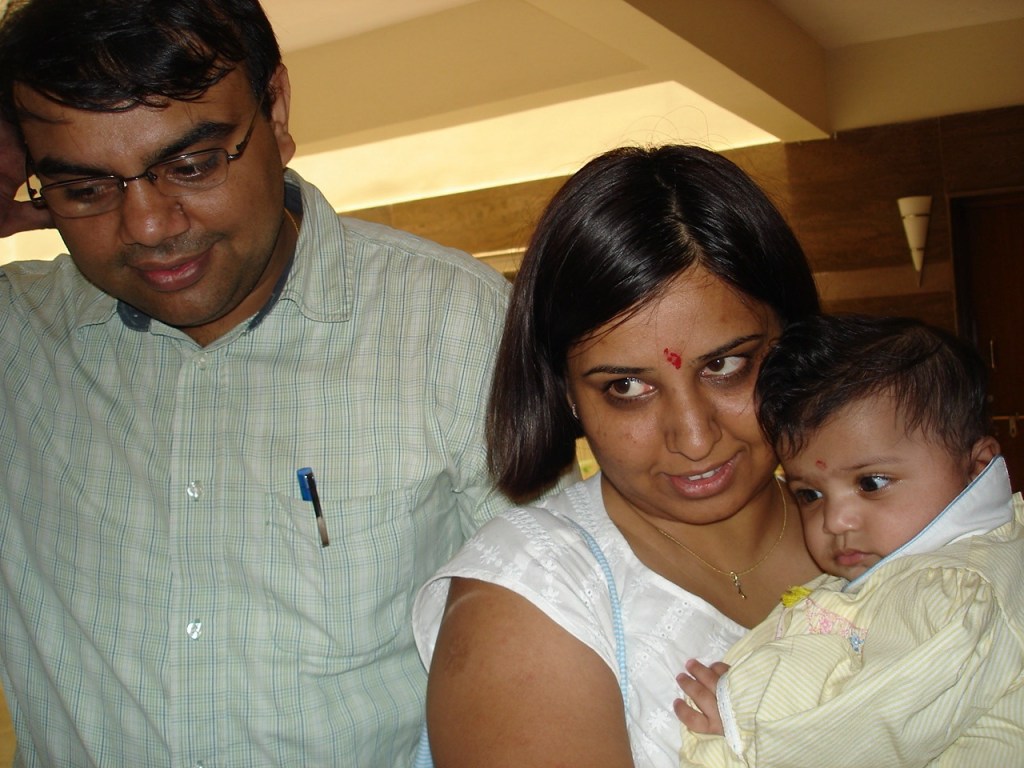
When Kanchan Gupta and her husband decided to adopt, they expected the process to take a while.
They began the adoption process in 2008, when the system in India was less regulated than it is today. They visited the CARA office in Bangalore, registered with different institutions and were told that there could be years of waiting ahead.
At one point, an institution even questioned why they wanted to adopt when they were young and could have biological children. “They thought that we were too young,” Gupta said, “and the fact that we could have kids but yet choose to adopt was something that they couldn’t kind of get around to.”
Another institution in Delhi was not even accepting registrations. “There was, say, three years before we could make a registration,” she said.
Then a friend connected the couple with an NGO in Pune, Catalyst for Social Action, which put them in touch with Snehalaya in Ahmednagar. “Once we went and visited over there, in about three to four weeks, we had our child home,” Gupta said.
After all the uncertainty, suddenly there was a six-month-old baby in their house. “Considering that people were saying, ‘You need to wait for three years to register,’ to, you know, within four weeks we had a baby home,” she said.
The speed of it all did not make the experience easy. “To get to that point was a long and tough journey, unpredictable, not knowing whether it’ll happen, not happen, stuff,” Gupta said.
And once her daughter arrived, Gupta discovered that getting a child home was only the beginning. “There wasn’t much counseling or anything in India at that point in time,” she said. “So it was like, ‘Burn your fingers and learn.’”
One of the first things she had to learn was something she had never thought about before: her daughter did not automatically understand that Gupta was her mother. “My first lesson learned was that she doesn’t know we are her parents or I’m her mom,” Gupta said.
For a six-month-old, Gupta explained, there was no automatic distinction between her parents and other adults. “For her, whether it is me or the security guard of the building or anybody, they’re all the same,” she said.
So the family had to teach her who belonged in her inner circle and what those relationships meant. “We need to teach her of, you know, who her inner circle is, who our parents are, and then who the outer circle is, and all of that,” Gupta said. “It took a while.”
That was one of the first moments when Gupta realized that raising her daughter would require her to pay attention to things she might not otherwise have thought about. As her daughter got older, there were more moments like that.
Gupta started noticing certain behaviors, but she did not immediately know what they meant. And when she asked other people about them, the answers were often pretty simple. “Most people would say that, you know, ‘Oh, it’s normal. She’s just a kid,’ and all of that,” she said.
As her daughter got older, though, some of the challenges became harder to ignore. “As she grew up, some of these challenges kept getting bigger and bigger,” Gupta said. Still, she found that many of the people she turned to continued to explain the behavior as something ordinary.
“Most of the people that we could reach out to just told us that it’s a function of either, you know, she’s a kid, or all adolescents are like that, or all teenagers are like that,” she said. Eventually, Gupta and her husband realized that they needed to understand more themselves.
“We kind of started learning and studying about it,” Gupta said. “And changing our ways to understand what she’s probably going through and, you know, what is the impact she’s had, and then working through all of that.”
Gupta also decided from the beginning that adoption would not be a secret in their family. They told their daughter she was adopted from a young age, adjusting the explanation as she became old enough to understand more. “When she was way younger, a toddler, it was in the form of a story,” Gupta said.
The story was that God had come to them in a dream and told them that there was a gift waiting for them in another city. “You came, God came in our dreams and, you know, told that there is a gift for you in this city. You need to go pick it up,” she recalled.
“As she grew, it started kind of getting more realistic, the story,” Gupta said.
For Gupta, talking about adoption was therefore not something that happened on one particular day. It was something that developed along with her daughter. That became especially important because adoption was not always something people around them understood.
Gupta remembers hearing comments from relatives about genetics and her daughter’s background. “You face all this stigma, right?” she said. People would ask, “‘Oh, they’re not your genes,’” or “‘You don’t know what background they’re coming from,’” or “‘We don’t know how they’ll turn out.’”
The comments were often framed as concerns, but Gupta eventually learned not to let them dictate how she parented. “You kind of just shut it out and do your thing,” she said.
She has also noticed that the way people talk about adoption has changed since she first adopted her daughter. “Absolutely,” she said when asked whether attitudes toward adoption have changed. “At least in urban India, it has definitely changed,” Gupta said.
She has noticed more adopted children around her than she did when her daughter was younger. “There are more of these kids around us,” she said. “While earlier, maybe around five, six, 10 years ago, there would be one out of so many. Now that number is slightly better.”
But she does not think adoption has become completely ordinary. “It’s still a minority, and it will continue to remain that way,” she said. “But definitely more and more people are going in for adoption.”
Her own involvement with adoption continued long after her daughter came home. During COVID, Gupta saw a post in a common Facebook group about children who had lost their parents because of the pandemic. She and her family offered to foster some of the children.
That was how she met Radha Nagesh and became connected to the community that would eventually become Joy of Adoption. By then, Gupta had already been an adoptive parent for more than a decade. What she needed was not someone to explain what adoption was. She had already lived it. What she found useful was having people she could actually ask.
“In India, we did, until this, lack a structured support system for parents, adoptive parents, and children,” Gupta said. The community gave parents a place to exchange experiences and ask questions that might be difficult to raise elsewhere.
“It’s kind of a safe space where you can ask any question and not feel judged or anything,” she said. “And, you know, you can share any of your concerns, and people will chip in to help answer those.”
For Gupta, that matters because adoption questions do not necessarily disappear once the paperwork is finished. Her daughter’s adoption happened when she was six months old. But Gupta was still learning about what adoption meant when her daughter was a toddler, a child and eventually a teenager.
Looking back at those first years, Gupta said the biggest challenge was that there was not always someone to tell her what she was looking at. “Nobody told us that it would be different from raising a biological child,” she said.
That did not mean every part of raising an adopted child was completely different. Instead, Gupta learned that there were certain things she needed to think about more deliberately. She had to think about how her daughter understood family, when and how to talk about adoption, and she had to learn when to stop listening to people who insisted that everything was “normal” and start looking for answers herself.
That is part of why the community she later found became useful. “Overall, it’s always nice to have a support system,” Gupta said. Her experience with adoption also changed the way she thinks about parents who are just beginning the process.
The family she was part of in 2008 did not have access to the same kind of information and community that she has now.
Back then, the process could feel like a series of disconnected conversations: an office in Bangalore, an institution that said there was a long wait, a home study, another organization that was not accepting registrations, a friend with a contact in Pune, and eventually a trip to Ahmednagar.
Then, after all of that, a baby was suddenly coming home. Gupta still remembers the strange contrast between how long the process felt and how quickly everything eventually happened.
“You know, within four weeks we had a baby home,” she said. The more difficult part, she learned, was not necessarily bringing her daughter home. It was figuring out what to do once she got there.
Nearly 18 years later, Gupta is still figuring some of it out. Her daughter is now 17, old enough that the questions surrounding adoption are no longer the questions of a six-month-old or a toddler.
Gupta’s approach has changed with her. She does not present her experience as a perfect formula for another family. In fact, much of what stands out about her story is how much she did not know at the beginning.
And, eventually, she learned that there were other adoptive parents who were doing the same thing. Even after her own adoption process ended, that is what has kept her connected to the community.
