
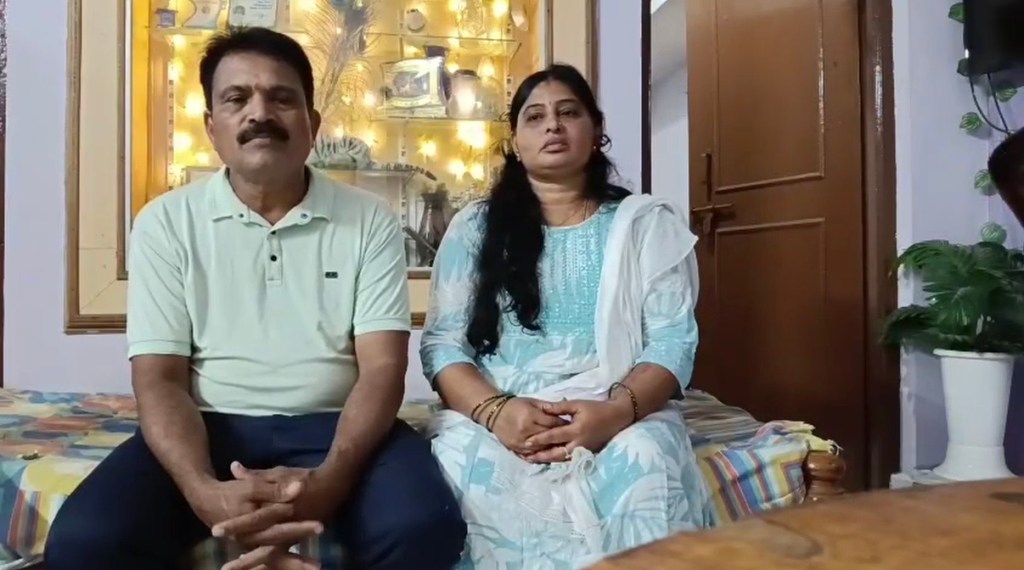
Before their son came into their lives, Neelegowda and Shoba had already spent years chasing a different kind of hope. Without children of their own, the couple had begun the difficult road of IVF treatment. It was only partway through that journey that they learned adoption was an option open to them — and once they knew, the decision became easy.
“If we had received this information earlier, we would have adopted a child sooner,” Shoba says. “We received the information a bit late.”
“As soon as we got this information, the first thing that came to our mind was, we don’t want an IVF baby,” Neelegowda explains. “We decided to adopt a child and give him a life too. Now he got a life, and from him, we also got a life.”
What they don’t shy away from describing is just how much sadness had settled into their home in the years before he arrived. “Earlier, there was a lot of sorrow in our house,” Shoba says. “No celebrations were happening properly. We couldn’t attend anything anywhere. Because when others came with all their children, it hurt us to go as just the two of us.”
Neelegowda describes the same years in even starker terms — not through his own eyes, but through what he watched happen to his wife. “I always call my wife as ‘my life.’ That life of mine had become like a lifeless being. I couldn’t bear to look at her face. She was not happy. She wouldn’t come for any celebrations, or any events or programs.”
The couple’s path to Shishu Mandir began with what they describe as full transparency from staff, who explained the rules, checked their documents, and helped the couple process feelings they had been carrying for years. “We, our pains, and conveyed all our feelings to them,” Neelegowda recalls. “They told us everything they had to say according to the rules, giving all that information, and checked all the big documents we had.”
Then came the moment neither parent has fully let go of since.
“After that, they allowed us to see the baby. That was an unforgettable moment,” Neelegowda says. “When that baby came in front of us, we forgot ourselves.”
Staff had warned the couple that bonding could take months — that adjustment would come slowly. What happened instead stunned everyone in the room. “Salma Madam and Ramesh Sir from Shishu Mandir were there. They called that child and said, ‘Look, your parents have arrived.’ He first came and sat on my lap. I couldn’t forget his touch,” Neelegowda says. “Then I sent him there, telling him to go to his mother. After coming and settling into his mother’s lap, he, even more happily, near his mother — after seeing the moment he sat there, leaning against his mother, for a moment, all those happy staff members became somewhat speechless. Because it was so quick, I have never seen such an adjustment happen in just a moment.”
The feeling that settled over the family in that instant was one Neelegowda struggles to categorize as anything but fate. “I truly felt, this isn’t our child, but someone from the past — one of us, maybe my mother, maybe my father, or some other uncle, aunt — as if they have already come into our lap and joined us. This is such an experience. I became very happy.”
Shoba’s memory of that same first meeting is simpler, but no less absolute: “We didn’t feel it was a different baby at all. We felt our own baby was here. His touch, we just couldn’t bring ourselves to leave him.”
The transformation the couple describes after bringing their son home is not a gentle one — it is total. Shoba says the family that once avoided gatherings now can’t stop hosting them: “Now, after he arrived, it seems there’s a celebration or function every week in our house. After that, all of us are very happy. We will never forget this celebration.”
Neelegowda describes the same shift in physical, almost architectural terms — light returning to a house that had gone dark. “Before that, it was as if, in our house, no matter how much light there was, it felt dark. Because there was no happiness at all.” He recalls the old pattern of forcing himself to attend relatives’ functions alone with his wife, “ready and prepared,” while watching other families arrive with their children — a “situation that brought a bit of sadness,” enough that he says, “I had decided not to go to such functions at all.”
Now, he says, “it’s like one or two functions a month have started happening at our house now.” And it isn’t only the family that has noticed the change in atmosphere. “Our neighbors, seeing how he talks, his innocence, and all that — they aren’t leaving much with us. They are all taking him to their homes. Even relatives.” Friends tease the couple that the resemblance is uncanny: “Oh, are you lying? He is exactly like you. If you left your child somewhere, he has impressed us so much that you would bring him and lie.”
Shoba sums up what the boy has given them in a single line: “He has no selfishness. He stays with love, with affection, in a sentimental way.”
Neelegowda goes further, describing his son’s arrival as something earned across lifetimes: “I say that getting him was the punya — the merit — of many births. After he came, truly for us, earlier it was a kind of painful. If tears used to come, now tears of happy joy are coming.” And of his wife, restored: “Now she is fast in everything, happy, and healthy. Now these two are my two eyes in my family.”
Not every part of the family’s story is uncomplicated, and Neelegowda doesn’t edit that out. He recounts the day his son turned around and asked the question every adoptive parent eventually faces.
“He asked us once — why was I there. He asked why I was left there. I didn’t know what to say,” Neelegowda admits.
His wife stepped in with an answer rooted in something true about their son — his early struggles with speech. “Meanwhile, my wife said, ‘Your speech wasn’t coming out properly, son. That’s why if you are left there, interacting with more children, you take care of the children.’ Assuming you speak very well, we left it at that.”
The resolution, as Neelegowda tells it, closed the moment with warmth rather than wound. “Later, you were speaking very well. After saying all this — that we brought you for this reason — he became very happy.” The boy later asked for old photographs from his time before the adoption, and the family keeps them ready to share: “He is asking for photos from when our baby was there. So we said, ‘Okay, we’ll give them, we’ve kept them there.’”
Neelegowda describes a boy who is disciplined, curious, and already articulating who he wants to become. “He keeps asking even now what you will become in the future. Even before we ask, he says he wants to become a police officer.” The couple has committed fully to whatever path he chooses: “Whether it’s his studies, his sports, or any dance, whatever he does, in his life, our cooperation is complete and encouragement will always be there.”
He also describes, almost in passing, the emotional logic that now governs the household — the refusal to let their son ever feel like anything other than their own. “We don’t feel he is an adopted child. We consider him our own flesh and blood. That’s why we maintain things that way. If he gets to know any matter, he won’t know at all. We are like that.”
Throughout both of their interviews, Neelegowda and Shoba return again and again to the staff who walked them through the process — describing an institution that felt less like a government office and more like an extension of family.
“Sheela Madam, like a family member, behaved like a senior member and helped us a lot,” Shoba says. “And all the other staff members were like our companions, like brothers, like sisters — they provided a lot of support for our child to come into our hands. I will never forget that.”
Neelegowda describes the same relationship in terms that have outlasted the adoption process itself. “Our Sheela Madam, as an elder and guide in our family, gave us complete support. And there, the office staff were like our family, like our sisters and brothers — they offered us so much, seeing us. It didn’t feel like we had come to an office. It was more like feelings of having come to a big house, being with a big family. We have maintained that even today. They have that kind of bond with us. Whatever function or program they organize, they call us, they talk to us, they inquire about us. They express their feelings, and we follow them. I will never forget their cooperation, in any lifetime.”
He adds, without hesitation, that he would do it again: “If you need someone to guide the children there, I will take another baby as well. If given, I will be very happy about it.”
Both parents are direct — almost insistent — in urging other childless couples toward the path they took, rather than the one they nearly chose first.
“To those who don’t have children, what we’d like to say is: rather than going for ‘IVF here and there,’ spending all the money and wasting it, give life to such children,” Neelegowda says. “You will get a life, and the child will also get a life. I feel that this is the right path. Instead of shedding tears because you have no children, and instead of suffering grief and pain — visit this adoption center. Those rules and regulations are there, follow them. Surely, you too will get a child, and your life will be set right.”
Shoba’s version of the same appeal is quieter but no less firm: “Many people who worry about not having children, please follow this. Instead of giving life to just this one child, if you get a child in your life — you are very good. It makes your life very fulfilling.”
Neelegowda closes with a line someone once said to him, one that he says turned out to be exactly true: “Your son won’t be born as a child to your house. Children are gods — they will come to your house as children. That turned out to be very true.”
And beneath all of it, the disbelief of two parents who say the child they received exceeded anything they had imagined. “We never even imagined in our dreams that we would get a child like this,” Shoba says. “He has more talent than we expected. He is very much to us — we never get any feeling that ‘he is not our child.’”
“We are here for the good, and we are praying for everyone’s well-being,” she adds. “May such cooperation be received by everyone from you. I pray to you that this may remain for hundreds of years in peace.”

One response to ““Now These Two Are My Two Eyes”: Neelegowda and Shoba’s Heartwarming Adoption Story”
Shishu Mandira involvement in enabling a smooth transition is exemplary. This first person account corroborates it beautifully. A joy to read this.
LikeLike